Sohan Halwa Recipe | Dera vs Multani — Our Bakery's Soft Halwa

Sohan halwa is the sweet that every Pakistani gift box knows — golden, nut-studded, and chewy in a way no other mithai is. But here is the thing most people do not know: the sohan halwa of Dera Ismail Khan and the sohan halwa of Multan are not the same recipe at all. One is soft. The other is hard enough to snap. I am Kashf, and I work with the soft one every day. In this article I will share our bakery's own factory recipe exactly as it runs on our counter, and then scale it down into a home version that works in a home kitchen — with no glucose, the way our home halwa is made.
Recipe at a Glance
| At a glance | |
|---|---|
| Prep time | 20 minutes (plus soaking the angoori, if you sprout it yourself) |
| Cook time | 2 to 3 hours of slow stirring |
| Total time | About 3 hours 20 minutes, plus 6 to 7 hours to set |
| Yield | About 950 g — around 20 pieces |
What Is Sohan Halwa?
Sohan halwa is a dense, sweet confection made by cooking milk, sugar and sprouted-wheat flour together for hours, until the mixture turns glossy, chewy and golden, and then setting it in a tray with almonds and pistachios on top. It is one of the oldest sweets of the region — the name is said to come from a halwai called Sohan Lal — and it is the gift sweet of Punjab: the one that travels in tin boxes to relatives in other cities and other countries. Unlike most halwas, which are soft and spoonable, sohan halwa sets firm enough to cut into squares or discs, and it keeps well.
What Is Angoori — the Soul of Real Sohan Halwa?
Every real sohan halwa starts with angoori — also called sooni, or samnak. It is wheat that has been sprouted for 2 to 3 days, then sun-dried and ground into flour. The sprouting is what gives sohan halwa its character: the enzymes from the sprouted grain give the halwa its chewy, stretchy texture, the pull you feel when you break a piece. Modern recipes that leave the angoori out and use only maida still make a sweet halwa — but it is a different sweet. It does not chew the same way.
At home, you have two honest choices. Sprout the wheat yourself — soak it, let it sprout for 2 to 3 days, dry it in the sun and grind it. Or buy ready sprouted-wheat (samnak or angoori) flour from a mithai shop or a pansari — that is what most home cooks do, and it works. What you should not do is replace it with semolina and call it the same halwa. Our factory batch uses only a light quantity of angoori — 700 g against 77 litres of milk — because our halwa is milk-heavy and soft. Multani home recipes use more angoori and less milk, which is one reason theirs turns out harder.
Our Bakery's Batch — Kashf's Own Formula
This is the real recipe from our bakery counter, for one full factory batch of sohan halwa — shared exactly as it is written on our production screen, no rounding, no hiding:
| Ingredient | For one factory batch |
|---|---|
| Milk | 77 litres |
| Sugar | 11 kg |
| Maida | 7 kg |
| Liquid glucose | 4 kg — factory batches only, never at home |
| Ghee | 1 kg |
| Sooni (angoori — sprouted wheat) | 700 g |
That batch makes 36.7 kg of halwa. Two things about it are worth noticing. First, it is milk-heavy — 77 litres of milk against 7 kg of maida — and that milk is the whole secret of the soft Dera texture. Second, the liquid glucose is a factory ingredient only. At home, we never add glucose. The home halwa sets by slow cooking alone, and it stays softer for it.
The Home Version — 2-Litre Batch for Your Kitchen
A 77-litre factory batch is not a home recipe, so here is the same recipe scaled down to 2 litres of milk — about 950 g of halwa, around 20 pieces. The home version keeps Kashf's formula pure, with one honest change: the milk is curdled first, with tatri, the way home cooks have always done it.
For the home batch, you need:
• Milk (full cream) — 2 litres
• Sugar — 286 g (about 1½ cups)
• Maida — 182 g (about 1½ cups)
• Ghee — 26 g (about 2 tablespoons), plus a little more for greasing the tray
• Sooni / angoori (sprouted-wheat flour) — 18 g (about 2 tablespoons)
• Tatri (citric acid / lemon salt) — 1 teaspoon, dissolved in a little water — or 2 tablespoons of lemon juice instead
• Cardamom (elaichi) — 4 to 5 pods, crushed, or ½ teaspoon powder
• Almonds and pistachios, sliced, to mix in and to garnish — walnuts too, if your family likes them
Make it tastier at home — your own choice: the factory batch follows one fixed formula, but at home this halwa is yours to finish. Add the dry fruits your family loves — sliced almonds, pistachios, or walnuts (akhrot) — mixed in, scattered on top, or both. And if your family likes the rich taste of desi ghee, stir in an extra spoon or two while it cooks. These small additions do not change the recipe — they make the same soft halwa taste like your own home's halwa.
Method:
1. Mix the sooni and the maida with a little of the milk into a smooth paste, with no lumps. Keep it aside.
2. Pour the rest of the milk into a heavy-bottomed pan and bring it to a boil, stirring now and then so it does not catch.
3. Turn the heat down. Add the tatri water — or the lemon juice — a little at a time, stirring gently, until the milk curdles. Stop as soon as it curdles; you may not need all of it.
4. Stir in the flour paste, then the sugar and the ghee. Keep the flame at medium-low.
5. Now comes the long part: cook and stir, and keep stirring, for about 2 to 3 hours. The water cooks away slowly and the mass thickens and turns glossy. Do not rush it and do not walk away from it — this halwa burns easily if it is left alone.
6. You will know it is ready by two signs every home cook agrees on: the halwa starts to leave the sides of the pan, and the ghee separates and shines on the surface. The mass holds together in one glossy lump.
7. Stir in the crushed elaichi and half the nuts — the elaichi always goes in at the end, off the heat, so its aroma survives the long cooking. Pour the halwa into a greased tray, press it flat with a greased spatula, scatter the rest of the nuts on top and press them in lightly so they stay in place.
8. Let it cool and set for 6 to 7 hours — overnight is best — then cut it into squares and serve.
Watch it being made — the slow stir and the setting, in under a minute:
Factory Batch vs Home Batch — Side by Side
One recipe, two kitchens. Every figure below is already in this article — the factory column is Kashf's own batch from the bakery counter, and the home column is the same recipe scaled down, with the one honest change home cooking needs (the milk curdled with tatri, and no glucose).
| Ingredient | Factory — one batch (36.7 kg) | Home — 2-litre batch (~950 g) |
|---|---|---|
| Milk | 77 litres | 2 litres |
| Sugar | 11 kg | 286 g |
| Maida | 7 kg | 182 g |
| Liquid glucose | 4 kg | — (never at home) |
| Ghee | 1 kg | 26 g (+ greasing) |
| Sooni / angoori | 700 g | 18 g |
| Tatri (to curdle the milk) | — (factory method) | 1 teaspoon — or 2 tablespoons lemon juice |
| Cardamom | — | 4 to 5 pods |
The ghee is the one thing that looks low — our factory uses only 1 kg of ghee for 77 litres of milk, while most home recipes use much more, about 33 to 55 g per litre. The milk does the work here: it is cooked down slowly until the halwa leaves the pan. If your pan is thin, add one extra tablespoon of ghee while stirring so nothing sticks — that is a home-cook fix, not a change to the recipe.
At a Dera Counter, Sohan Halwa Comes in Categories
Walk up to a sohan halwa counter in Dera and you will not be asked "which halwa?" — you will be asked which kind. The counters sell it in proper separate categories, and every regular knows their own. By base and fat: Desi Ghee wala, the premium one; Simple or Sada, the classic plain; Without Ghee, the oil-free one; White Halwa; and Sada Bahar. By dry fruit: Badami (almond), Akhroti (walnut), Pista (pistachio), Coconut, and Khushkash (poppy seed). There are sugar-free and fat-free kinds too — more than twenty varieties in the shops altogether.
All of them branch off the same base you have just read. Change the fat, or change the topping, and the same halwa becomes a different category. The recipe in this article is the classic base — learn it once, and every category is just one small change away.
Dera Ismail Khan vs Multan — Two Different Recipes
This is the comparison every reader asks for, so here it is plainly — two cities, two halwas, both made with pride, and neither one better than the other. It is a matter of taste, the way it should be.
| Aspect | Dera Ismail Khan | Multan |
|---|---|---|
| Texture | SOFT — the headline difference | Hard, brittle, caramelised |
| Shape | Set in trays, cut into soft squares | Thin round discs (5–6 mm) or bite-size squares |
| Base character | Milk + khoya richness; sooni in a light quantity (our batch: about 9 g per litre of milk) | Angoori / samnak more prominent (home recipes: about 16–42 g per litre), with maida |
| Curdling | Tatri — or lemon juice at home | Citric acid (lemon salt), sometimes with alum |
| Glucose | Not at home (factory batches only) | Common, including in many home recipes; some makers skip it |
| Ghee | Desi ghee taste prominent; our batch about 13 g per litre | Generous — home Multani recipes about 33–55 g per litre |
| Dry fruits | Almonds + pistachio on top | Walnut is the signature, with almond, pistachio and cashew |
| History | Took its form in the 1920s–30s; Qadeemi Sohan Halwa Shop, Topan Wala Bazaar | Old Multan tradition; the nationally famous gift halwa |
| Famous makers | Qadeemi (Topan Wala Bazaar); Baloch Hotel (since 1976) | Hafiz (making halwa since 1930; brand from 1963); Al Jannat (since 1965) |
| Keeping | Soft — best fresh | Hard — keeps long, travels well as a gift |
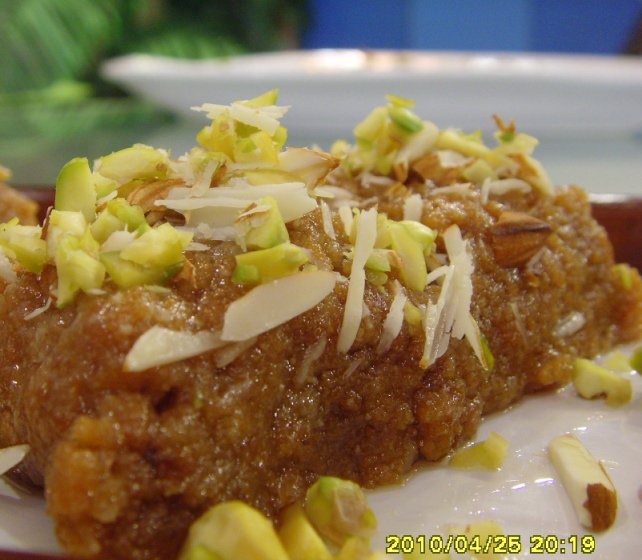
Photo: Multani sohan halwa discs, by Bhutta1984, via Wikimedia Commons, CC BY-SA 3.0.
Bakery Secrets That Make It Soft, Not Hard
• Never stop stirring. Two to three hours sounds long, and it is long — but the halwa thickens only with steady stirring. Stop, and it catches at the bottom; hurry the flame, and the sugar overcooks and the halwa turns hard instead of soft.
• Curdle gently. Add the tatri water a little at a time and stop as soon as the milk curdles. Too much tatri makes the halwa sour.
• Judge by the pan, not the clock. The two signs never lie: the halwa leaves the sides of the pan, and the ghee separates and shines. Until both happen, keep stirring.
• Let it set fully. Six to seven hours in the tray is not a suggestion — cut it early and it falls apart. Overnight is best.
• Sugar is the hardener. Undercooked sugar will not set; overcooked sugar turns the halwa hard and brittle. That is the whole difference between the soft Dera piece and the hard Multani disc — the same sugar, cooked a little further.
Myth vs Fact
Myth: "Sohan halwa needs glucose, or it will not set."
Fact: No. Glucose is a factory shortcut for big batches. At home, slow cooking sets the halwa — the milk reduces, the sugar thickens, and the halwa holds. Our home version has no glucose at all, and it sets.
Myth: "Dera halwa and Multani halwa are the same recipe."
Fact: They are two different recipes. Dera is milk-heavy and soft; Multani is angoori-heavy and hard. Same family, different halwa — and both are loved in their own cities.
Myth: "More ghee always means a better halwa."
Fact: Our factory batch uses very little ghee — 1 kg for 77 litres of milk — and it is still the halwa people queue for. The milk, cooked down slowly, does the work. More ghee helps a thin pan, but it does not make a better halwa.
Frequently Asked Questions
What is angoori (sooni) and where do I get it?
Angoori is sprouted wheat — wheat sprouted for 2 to 3 days, sun-dried and ground. It is the soul of real sohan halwa and gives it the chewy, stretchy texture. Sprout it yourself, or buy ready sprouted-wheat (samnak or angoori) flour from a mithai shop or a pansari.
Can I make sohan halwa without glucose?
Yes — this whole recipe is made without it. Glucose is a factory-batch ingredient; at home, slow cooking does the setting. Without glucose the halwa stays softer, which is exactly the Dera style.
Why did my sohan halwa turn out hard instead of soft?
Almost always the sugar cooked too far, or the milk was not enough. Our Dera version is milk-heavy and cooked until it just leaves the pan — cook it further and it hardens into the Multani style. Keep the flame low, stir steadily, and stop at the two signs: the halwa leaves the sides and the ghee separates.
Dera or Multani — which one is better?
Neither. It is a matter of taste, and every city loves its own. Dera is soft, milk-rich and best fresh; Multani is hard, caramelised and travels well as a gift. Try both, and keep the one your family asks for again.
From Our Bakery to Your Kitchen
Sohan halwa is proof that a sweet does not need a long ingredient list to be loved — it needs milk, patience, and a baker who watches the pan instead of the clock. Our factory batch has fed gift boxes for years, and the 2-litre batch above brings the same soft halwa into your kitchen — just as our nan khatai brings the bakery biscuit home, and our foolproof barfi brings the mithai counter home. Make a tray of it, let it set overnight, and serve it with chai the way it was meant to be served: one golden square at a time, gone too soon. And if you like keeping your recipes in one place, the printable Recipe Cards are made for exactly that — one card per recipe, ready for the kitchen wall.

Save this recipe on Pinterest for later.
More From Our Bakery Counter
If you enjoyed this sweet from our counter, our recipes are waiting for you. Start with the Nan Khatai — crumbly, melt-in-the-mouth, and our bakery's own 1 kg formula scaled for your kitchen. Or try the foolproof Barfi, plain, khoya, badam-pista and fruit, all in one recipe. And for a soft everyday bake, our crispy butter cookies never disappoint. See all our recipes on the Baking With Kashf homepage.
Coming Next on Baking With Kashf
On Wednesday, 18 November, a knowledge post from our bakery counter — why the same gulab jamun and rasgulla recipe changes with the season, and what the sheera has to do with it. Stay with us.
About the Author
I am Kashf — sharing the secret recipes of a branch of one of Pakistan's famous bakeries. Every recipe here is tested at our bakery counter and in my own kitchen.
Never Miss a Recipe
Get our free Mithai Rescue Chart and never miss a recipe from our bakery counter. Join free
Photo: Multani sohan halwa discs, by Bhutta1984, via Wikimedia Commons. Hero image: Kashf's pick from the two options made for this article (AI-generated, bright and glossy, in the blog's style).


Comments
Post a Comment