The Custom Cake Order: When the Colour Must Be Perfect (Even If the Cream Turns Bitter)
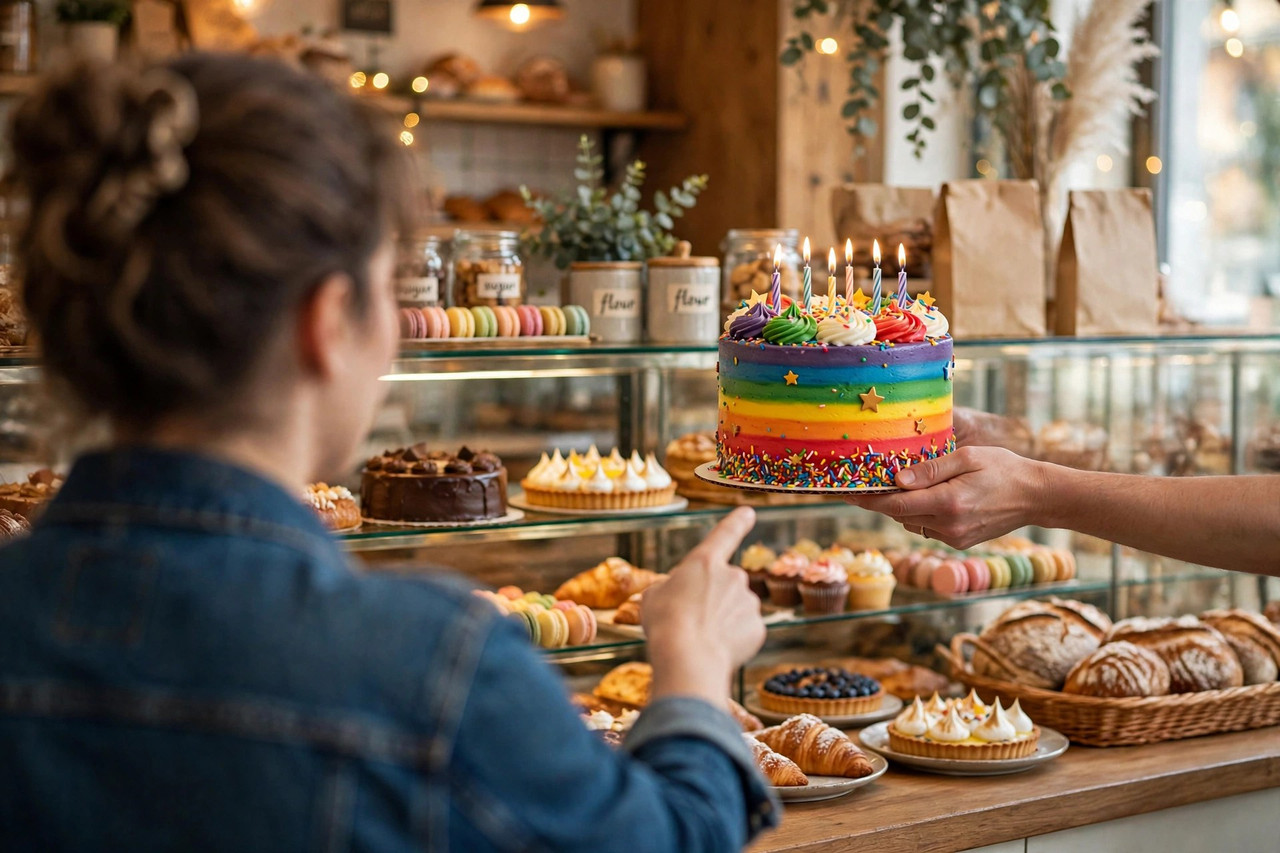
Taking a custom cake order is the hardest job in a bakery — and also the funniest. I am Kashf, and I take these orders at our bakery counter. A customer walks in with a picture on their phone, a colour in their mind, and a dream in their heart — and my job is to turn all three into one cake that weighs exactly what they asked for. Most days it works beautifully. Some days, the order itself becomes the story. This is that story — four moments every bakery person will recognise, told the way they really happen.
Watch: the colour trick in one minute
1. "The Colour Must Be Exactly This — Even If the Cream Turns Bitter"
The most famous words in a bakery (in Urdu, customers say it like this: "Colour bilkul yehi chahiye — chahe cream karwi ho jaye"): the colour must be exactly this — even if the cream turns bitter, the colour must stay that strong, and the shade and the shape must not differ at all. And here is the honest bakery truth behind it: a very deep colour really can make cream taste bitter. When a frosting needs a lot of food colouring to reach a dark red or a true black, the extra dye can leave a bitter, almost metallic aftertaste — that is not a rumour, it is what every cake decorator learns the hard way.
So what does a good bakery do? It uses gel colour instead of liquid colour, because gel is concentrated and a little goes a long way. It keeps a "no-taste" red on the shelf for deep reds. And it lets the colour develop overnight, because a colour deepens as it rests — which means less dye, a sweeter cream, and the same bold shade. The colour stays exactly as asked. The cream stays sweet. Everybody wins — as long as nobody insists on pouring in half the bottle.
And one rule from my own hands, after years at this counter: whenever you can, keep the colour light — or keep the cream its own natural colour. The less colour in the food, the better. Colour has never fed anybody; it is there for the eyes only. So let it stay a guest in the cake, never the host.
And then comes the question every child asks at the mithai counter: is there a gold and silver colour too? In food colours — the dyes that mix into cream — no. No colour bottle can make cream shine like metal; gold and silver never mix in, they sit on top. On mithai, it is varq — real silver, and sometimes gold, beaten thinner than paper and laid over barfi and kaju katli, with no taste of its own. On cakes, it is edible luster dust, brushed on dry or painted over fondant for a true metal shine. And here is the honest part, the way we tell it at the counter: genuine silver leaf is food-grade, 99.9% pure by food standards — but some cheap shiny sheet sold as "silver" is really aluminium foil, which is not the same thing at all. The old halwai test still works: rub a piece gently between your fingers. Real silver leaf melts away into nothing; aluminium rolls into a tiny ball.
And because this is Chatpata, here is the jugaar nobody prints. When a fondant name or decoration piece must shine like gold and there is no edible dust at hand, some bakeries reach for a tin of wood polish — the same polish sold for furniture — and paint the fondant piece with it. The shine is perfect. It is also not food. That piece is for the look only; it must come off the cake before anyone eats, and an honest bakery tells the customer so instead of staying quiet. The real thing costs more; the jugaar costs less. That is the whole story of a bakery, told by one shiny name plate.
The colour cheat sheet, from our counter:
| What you want | What a good bakery does | The honest note |
|---|---|---|
| Exact bright colour | Gel colour, added a little at a time | Liquid colour needs much more — and too much colour turns the cream bitter |
| Deep red | "No-taste" red colour | Ordinary red is the first colour to turn bitter |
| Strong colour, sweet cream | Colour the cream and let it rest overnight | Colour deepens as it rests — so less dye does the same job |
| Light, gentle colour | Very little colour — or plain cream | Colour has never fed anybody; it is for the eyes only |
| Colour with flavour | Fruit syrup in the cream — kiwi syrup for green | The syrup brings its colour AND its taste — so the dye bottle stays closed |
| Gold or silver shine | Varq leaf, or edible luster dust, laid on top | There is no gold or silver dye — and a wood-polish shine is NOT food |
2. The AI-Picture Cake
Then comes the phone picture. A perfect cake — glowing, flawless, every swirl in place — made by a computer, not by hands. "Just make it exactly like this." The honest answer is: a handmade cake will never look exactly like an AI picture, because a picture has no oven, no cream that melts, and no gravity. Real cream softens. Real colours settle. A real baker's hand shakes — just a little — and that little shake is what makes it handmade.
This is not a complaint. It is a fact of the craft, and every bakery person knows it: the picture is the dream, the cake is the real thing, and the real thing is beautiful in its own way. The best orders are the ones where the customer says, "as close as you can" — those cakes always turn out the loveliest, because the baker is free to make it well instead of chasing a pixel.
And here is the wonder I see every week: a customer shows me a picture of a rich brownie cake — dark, dense, heavy with chocolate — and then orders that same cake "in simple sponge". The picture is a brownie; the order is a sponge. When the cake arrives, light and plain, the face falls: "It does not look like the picture." Of course it does not. A sponge can wear a brownie's clothes for a photograph, but it cannot become a brownie on the tongue. If you want the cake in the picture, you have to order the cake in the picture.
And here is a thing I quietly wonder about at the counter. On these cakes we print everything — a country's flag, a school's name, a child's own face, even words and names that are dear and sacred to us. Then the same cake is cut with a knife and eaten, slice by slice, and nobody feels strange, because it is a celebration. Think of it this way — would you print your own photograph only to tear it up at a party? It would feel wrong, would it not? Yet on a cake, we cut through our own faces and names — and smile. But the cake would taste exactly the same without any of it. Joy does not need a photograph to be cut. Maybe the sweetest cakes are the simple ones — made well, shared warmly, and remembered for their taste, not their print.
3. The Flash Colour — or the No-Flash Colour?
The reference photo has one more secret: it was taken with a flash. Flash changes everything — it lifts the colour, sharpens the shine, and makes a soft pink look like a loud pink. The cake on the counter, in normal light, looks different. And then comes the question that makes every baker smile: does the customer want the flash colour, or the no-flash colour?
There is no wrong answer — but there is a right way to ask. A good bakery shows the colour in daylight, holds the picture next to the cream, and agrees on the shade before the mixing starts. Because once the colour is in the cream, there is no going back — and a cake that looked right under a flash can look like a stranger under the tube light.
4. The 1-Pound Miracle
And then, the hardest order of all. A 1-pound cake — that is all — but inside it must be everything: mixed fruit and ice cream and juicy filling and everything else besides. And the weight must stay exactly 1 pound. Not 1 pound 100 grams. Exactly 1 pound.
Any bakery person reading this is already laughing, because they have heard it too. A pound is a pound. Fruit has weight. Ice cream has weight. Cream has weight. You cannot fit a whole dessert table into one small cake and keep the scale at 1 pound — the scale does not negotiate. The kindest thing a bakery can do is explain it with a smile, and offer the next size up. The cake still gets made, the celebration still happens — and the scale stays honest.
And the tall ones! Triple storey, sometimes more — a cake standing taller than the child it was made for. People ask me how such a cake even reaches its destination without falling. The honest answer: slowly, on a flat board, kept in the flattest part of the car, while everybody in the vehicle prays quietly at every speed breaker. And once — a true story from our counter — a customer took his tall cake home in an ambulance, because it was the only ride he could arrange with a flat bed and a smooth journey. The cake reached safely, without a single crack. Some journeys are just meant to be grand.
The Honest Bakery Rule Behind the Laughs
There is a serious truth hiding inside all this fun, and it is the rule our bakery lives by. At home, nobody watches the cost — only the quality matters. In a bakery, cost is watched first, and quality is built around it. That is why bakeries have their shortcuts and quick fixes — the low-cost ways of getting things done fast. A good quick fix saves time and money. But it can change the taste a little, and an honest bakery says so plainly instead of pretending otherwise. The customer who knows the trade-off is the customer who comes back.
And If You Ask Me What I Would Order
After all this, people sometimes ask what I would order myself. Nothing printed, nothing polished. A simple two or three pounds, half and half. Inside, one half vanilla, the other half chocolate mousse. Outside, plain cream all over — and here is the small trick I love: on the vanilla side, red velvet sponge crumbs pressed onto the cream; on the chocolate side, brownie sponge crumbs. The cake itself tells you which side is which, so every guest cuts the flavour they love. No photograph to slice through, no flag to eat — just a cake doing its real job, honestly and well. That is my kind of celebration.
Myth vs Fact
Myth: "A handmade cake should look exactly like the picture."
Fact: A picture — especially an AI picture — has no oven, no melting cream and no gravity. A handmade cake is real, and real is beautiful in its own way. "As close as you can" always bakes better than "exactly like this."
Myth: "More food colour just means a brighter cake."
Fact: Too much colouring, especially for deep reds and blacks, can make the cream taste bitter. Gel colours, "no-taste" reds, and letting the colour develop overnight keep the shade bold and the cream sweet.
Myth: "The silver sheet on mithai is just shiny decoration foil."
Fact: Real varq is edible silver of 99.9% purity, made to food standards. The danger is the fake — aluminium foil passed off as silver. If it feels thick, folds like foil, or rolls into a ball when rubbed between your fingers, it is not the real thing.
Myth: "A 1-pound cake can hold everything if the baker is skilled enough."
Fact: A pound is a pound. Every filling adds weight, and the scale does not negotiate. The next size up is not an upsell — it is physics.
Frequently Asked Questions
Why does my red frosting taste bitter?
Because deep red needs a lot of dye, and too much dye leaves a bitter, metallic aftertaste. Use a gel colour instead of liquid, try a "no-taste" red, and mix the colour the night before so it deepens on its own — you will need far less of it.
Can a bakery copy my phone picture cake exactly?
Not exactly — and no honest bakery will promise it. A handmade cake follows the picture as closely as real cream and a real oven allow. Bring the picture, agree on the colour in daylight, and the result will be the closest — and the tastiest — version of it.
Why does the cake colour look different in my photo?
Flash lifts and sharpens colour, so a cake photographed with flash looks brighter than the same cake in normal light. Judge the shade in daylight, not under a flash, before you approve it.
Can I get mixed fruit, ice cream and juicy filling in a 1-pound cake?
Honestly, no — not all of them together at exactly 1 pound. Every filling adds weight. Pick your favourite one or two for a 1-pound cake, or go one size up and have them all.
A customer told me this story with a straight face. He had ordered a special cake — proper sponge layers inside, caramel, Lotus, the works — and paid the special price for it. Then he saw the same design at another shop for much less, and asked the first baker why his cake had cost so much. Here is the thing nobody says out loud at the counter: until a cake is cut, nobody can see what is inside it. The outside look can be copied in a day; the inside cannot be seen at all. So the eye compares two cakes and calls them the same — while the tongue, later, quietly tells the truth. Common sense, really: the main thing you can see is the look. The main thing you eat is the inside.
And my favourite complaint of all: "This cake smells of egg. There is an egg taste coming from it." Said with full seriousness — about a sponge cake. Dear customer, sponge is made of eggs. That is not a fault in the cake; that is the cake. It is like complaining that the tea tastes of leaves. Very soon I will share our sponge recipes right here — simple sponge, chocolate sponge, special sponge — so you can see with your own eyes exactly what goes inside, and why it tastes the way it tastes.
My Personal Opinion, Baker to Reader
And since this is my page, here is my personal opinion. A cake should be built for its taste, not only for its look. A heart shape, a star shape, this colour, that colour — all of that is just the look; it does not bake the taste in. It is the same story as our weddings: the hall is beautifully decorated, the stage is shining, the photographer is working hard — and the guests, who actually came to eat, get whatever food was thought about last. My counter taught me the other way round: make the taste, and the look will follow. Make only the look, and nobody remembers the second slice. So when you order your next cake, ask one question first: will it taste wonderful? The shape can be decided after.
And here is the small law underneath it all: the wider a cake is spread, the fewer and thinner its cream layers, and the juicier its sponge — the tastier it will be. Juice in the sponge beats height in the air, every single time.
And if you ask me where taste truly lives, I will give you one name: the three milk cake. No decoration, no picture, no fondant work — a plain cake soaked in three milks, with nothing to hide behind, and taste in every bite. If enough of you ask for it in the comments, I will share our three milk cake recipe right here. Demand it, and it is yours.
More From Our Bakery Counter
If you enjoyed this peek behind the counter, our recipes are waiting for you. Start with the Nan Khatai — crumbly, melt-in-the-mouth, and our bakery's own 1 kg formula scaled for your kitchen. Or try the foolproof Barfi, plain, khoya, badam-pista and fruit, all in one recipe. And for a soft everyday bake, our crispy butter cookies never disappoint. See all our recipes on the Baking With Kashf homepage.
Coming Next on Baking With Kashf
On Monday, 16 November, the Sohan Halwa recipe — the golden, nut-studded sweet that takes hours of slow stirring, and the home version that actually works. Stay with us.
At the bakery counter — where every custom cake story begins.


Very delicious food ☺️
ReplyDeleteThank you so much, Rina! I am Kashf, and your kind words truly made my day. I hope you try one of our recipes soon — I would love to hear how it turns out for you. ♥
Delete